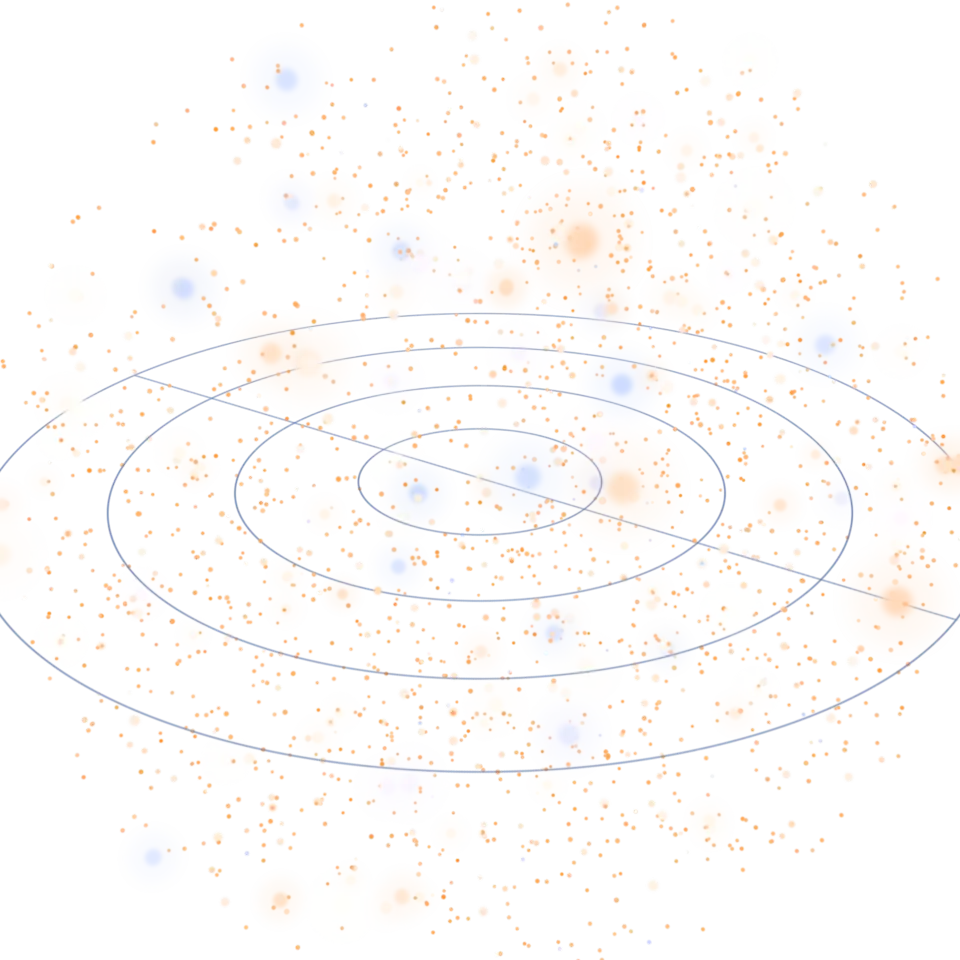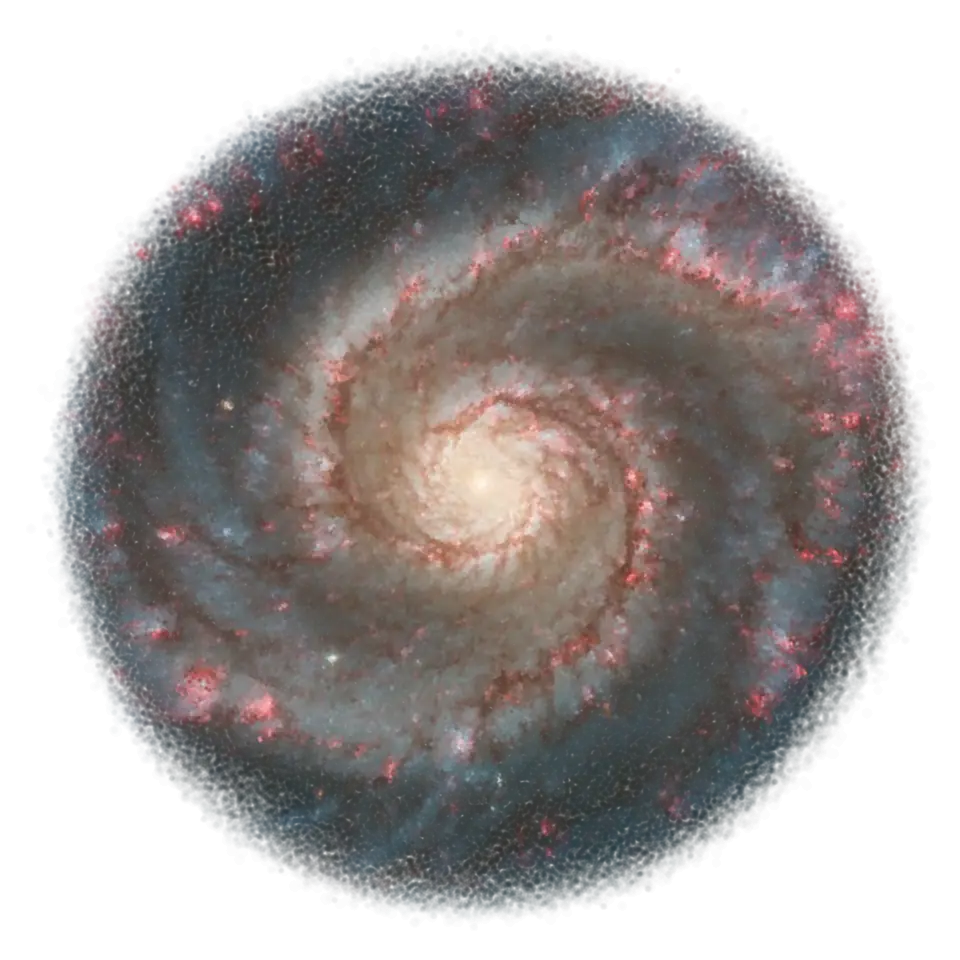
Fig. 86. §5 Space
Real Galaxies
Four real galaxies from telescope pictures: the Whirlpool (M51), the Pinwheel (M101) and the Phantom (M74) from the Hubble Space Telescope, and the Southern Pinwheel (M83) from the European Southern Observatory's Very Large Telescope.
1Facts
- Shelf
- Space
- Kind
- Built from a recipe
- Made from
- Every color is where the telescope's picture puts it; only the depth is a guess (a thin disk and a round bulge), which a tap shows by turning the galaxy edge on.
- Sound
- Yes
- Licenses
- CC BY 4.0
2How to play
Tap to turn the galaxy edge on and back. Pick another galaxy in the Splash tab.
3Its controls
Table I. Every control on this Splash.
| Control | Kind | Range | Start |
|---|---|---|---|
| Turn it edge on and back | Tap | ||
| Turn it edge on | Button | ||
| Galaxy | List | 4 choices | Whirlpool Galaxy (M51) |
4About it
Four real galaxies from telescope pictures: the Whirlpool (M51), the Pinwheel (M101) and the Phantom (M74) from the Hubble Space Telescope, and the Southern Pinwheel (M83) from the European Southern Observatory's Very Large Telescope. Every splat takes its color from the picture, so the arms, the pink clouds where stars are born and the dark lanes of dust are where the telescope saw them.
A picture shows nothing of how thick a galaxy is, so the thickness is a guess from galaxies seen edge on: a thin disk and a round bulge at the center. Tap to turn the galaxy edge on and see the guess. Foreground stars of our own Galaxy, and more distant galaxies, are drawn in its disk too.
5Is it right?
Four real galaxies drawn from telescope pictures: every color is where the telescope saw it. Their thickness cannot be seen in a picture and is a guess, which the splash says and shows.
Correct.
The colors come from ESA/Hubble's pictures of M51, M101 and M74 and ESO's picture of M83.[1][2]
tools/sp2-galaxies.mjs crops each picture round its galaxy; each splat takes the color of the pixel it is drawn from.
Simplified.
The thickness is a guess: a thin disk with an exponential height profile (scale height 3.5% of the radius pictured) and a round bulge.[3]
Each splat's height is drawn from a Laplace (two-sided exponential) distribution in the disk and from a ball in the bulge.
- [1]Usage of ESA/Hubble Images and Videos, ESA/Hubble
- [2]The Whirlpool Galaxy (M51) and companion, ESA/Hubble
- [3]Galaxy Disks, P. C. van der Kruit and K. C. Freeman, Annual Review of Astronomy and Astrophysics 49 (2011); arXiv:1101.1771
- Simplified
- The depth is guessed, not measured (said in the splash).
- Simplified
- The disk is drawn face on as photographed; the galaxies' small tilts to us (about 20° to 30°) are not undone.
- Simplified
- Stars of our own Galaxy in front of a galaxy, and galaxies far behind it, are drawn in its disk; M51's companion, NGC 5195, is cut off at the edge.
6Sources and credits
| Work | By | License |
|---|---|---|
| Whirlpool Galaxy (M51), heic0506a | NASA, ESA, S. Beckwith (STScI), and The Hubble Heritage Team (STScI/AURA) | CC BY 4.0 |
| Pinwheel Galaxy (M101), heic0602a | European Space Agency & NASA (ESA/Hubble) | CC BY 4.0 |
| Phantom Galaxy (M74), heic0719a | NASA, ESA, and The Hubble Heritage (STScI/AURA)-ESA/Hubble Collaboration | CC BY 4.0 |
| Southern Pinwheel Galaxy (M83), eso0825a | ESO | CC BY 4.0 |