Fig. 87. §5 Space
Powers of Ten
Every step of the zoom is ten times the last: the label names the power of ten, what you see and its size, and where the picture or data comes from, and the bar shows a round length at that scale.
1Facts
- Shelf
- Space
- Kind
- Built from a recipe
- Made from
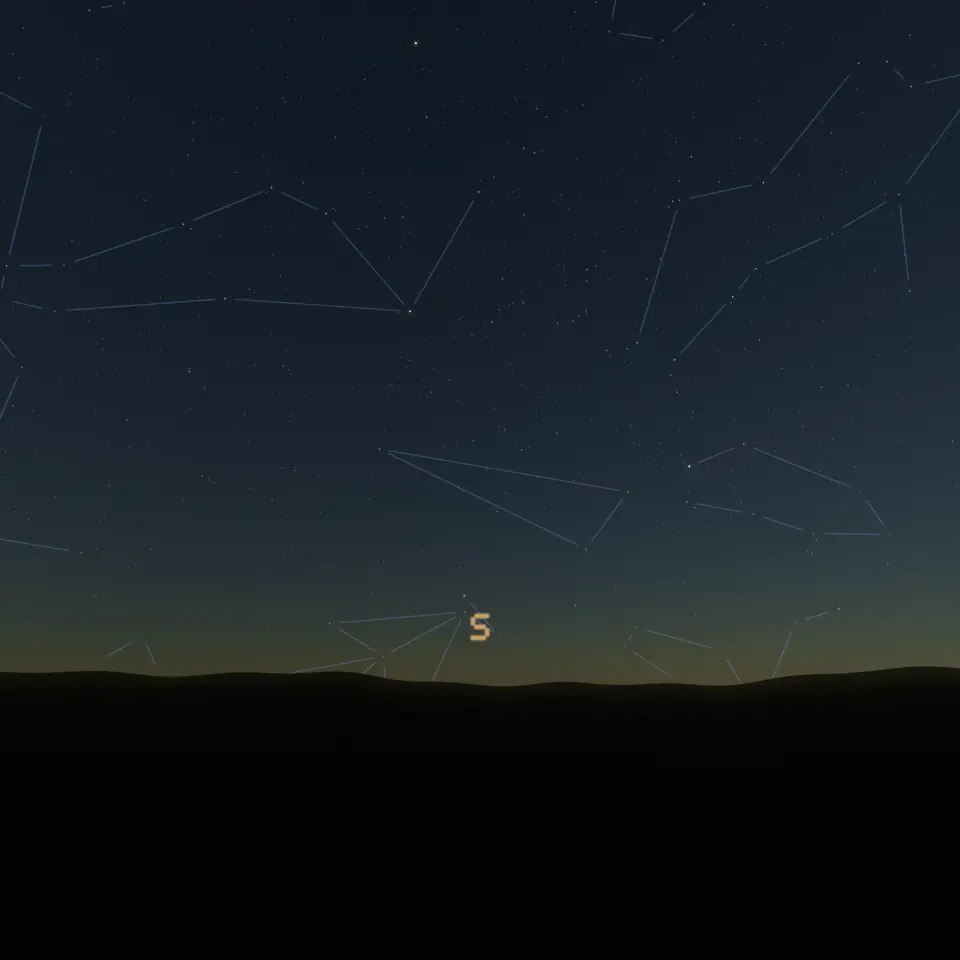
- Every scene is a real picture or real data at its true size; the planets, the Moon and the stars are where they were at 12:54 p.m. EDT on October 7, 2026, straight up from the garden. The Milky Way can't be photographed from outside: M83, a galaxy much like it, stands in at its size and tilt.
- Sound
- Yes
- Licenses
- CC BY 4.0, CC BY-SA 4.0, CC BY-SA 3.0 IGO, Public domain, CC BY-SA 2.0, CC BY 2.0
2How to play
Pinch, scroll or drag up or down to zoom from a garden to a galaxy or a molecule. Tap to play.
3Its controls
Table I. Every control on this Splash.
| Control | Kind | Range | Start |
|---|---|---|---|
| Play the journey | Tap | ||
| Play the journey | Button |
4About it
One continuous zoom through real scales, each a real picture or real data at its true size, centered on a garden bed beside the Smithsonian Castle in Washington, D.C. Every step of the zoom is ten times the last: the label names the power of ten, what you see and its size, and where the picture or data comes from, and the bar shows a round length at that scale.
Each scene sits inside the larger one, where it really is, and fades in as it fills the view; each is loaded only as the zoom comes near it. The garden bed is a 3D capture made elsewhere and set here.
5Details
- Turning
- Drag turns it left and right only, until Tilt lock is off
6Is it right?
One zoom through real scales, each stop a real picture or real data at its true size, centered on a garden beside the Smithsonian Castle. Each stop's label names its size; the list below gives each size and where it comes from. The planets, the Moon and the stars are placed for one real moment (16:54 UTC, October 7, 2026), straight up from the garden.
Simplified.
The Milky Way, about 100,000 light-years across. No one can photograph it from outside: this is M83, a spiral galaxy much like it, set at our galaxy's size and tilt.[1][2][3]
M83's picture (ESO), its disk masked, is laid in the galactic plane at 100,000 light-years across, its center at the real galactic center 8,178 pc from the Sun in the real direction (the J2000 galactic frame), seen from straight up over the garden at the zoom's moment.
Correct.
About 98,000 stars within 1,600 light-years of the Sun, where they really are.[4]
tools/pot-stars.mjs keeps the 97,823 HYG v4.4 stars with a distance up to 500 pc (1,631 light-years) and places each at its catalog x, y, z (equatorial J2000); dot sizes show brightness, colors temperature from B−V.
Correct.
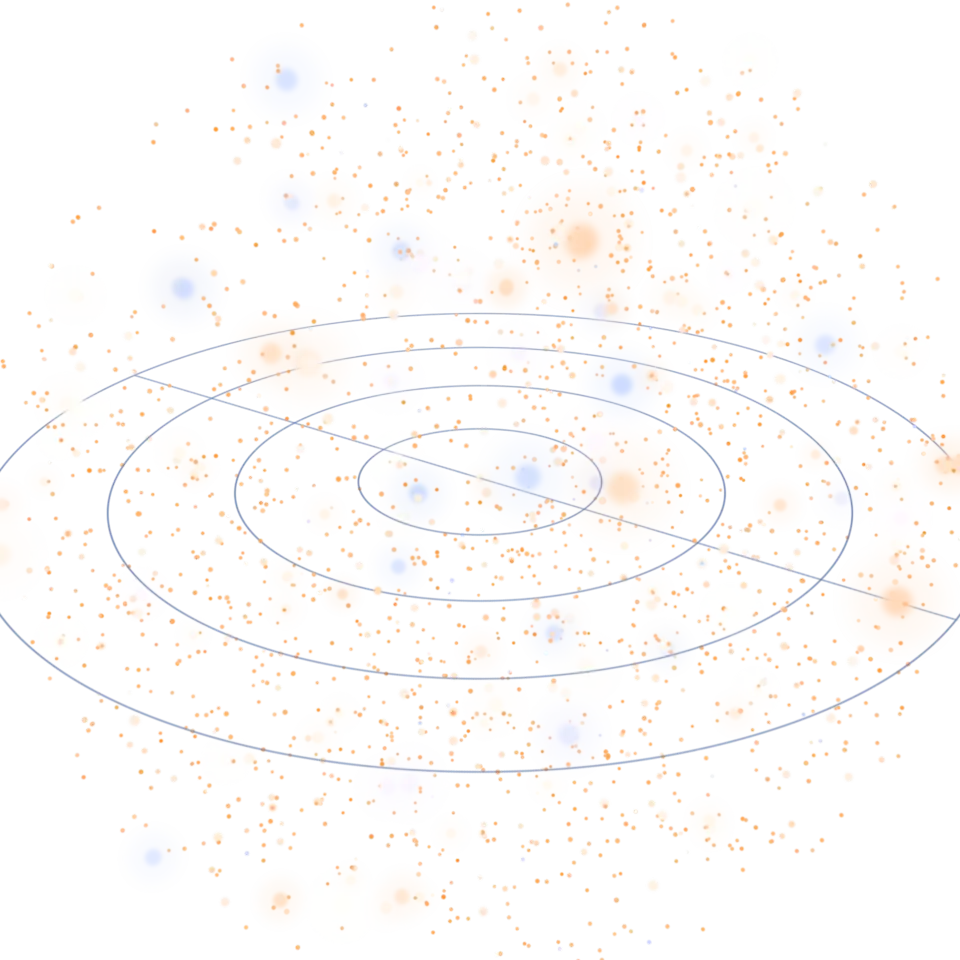
Every known star within 65 light-years of the Sun: about 2,200.[5]
Space r2's file of the stars within 20 pc (65.2 light-years): Gaia's nearby-star catalog plus the brightest stars it lacks from HYG, at their galactic x, y, z.
Correct.
One light-year: the Sun alone. Its Oort cloud of comets may reach this far, too small and dark to see.[6][7]
Only the Sun shows, as one bright dot, between the planets' orbits and the nearest stars.
Correct.
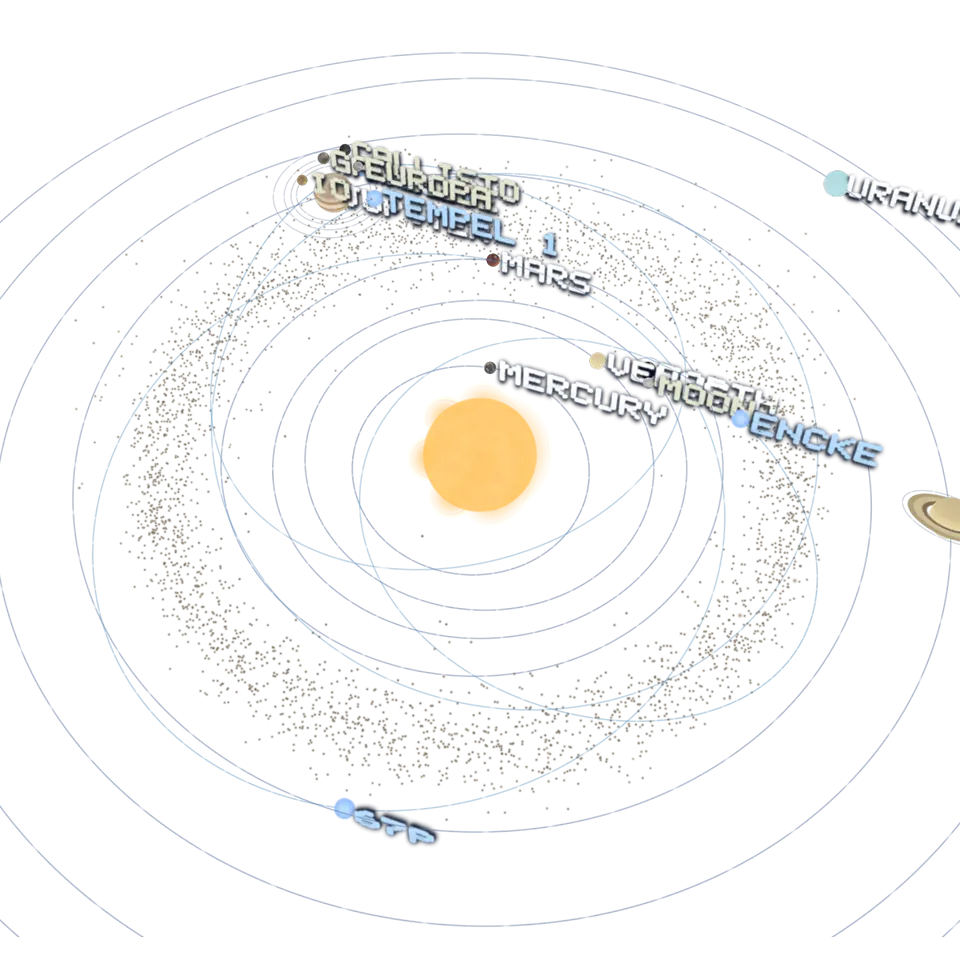
The Sun and the planets' orbits out to Neptune's, about 60 AU (9 billion km) across.[8]
Each planet's orbit and its place at 16:54 UTC on October 7, 2026, from JPL's Keplerian elements and rates (Table 1, 1800 to 2050), solved for the eccentric anomaly; Neptune's orbit (a = 30.07 AU) is about 60 AU across.
Correct.
Mercury, Venus, the Earth and Mars: Mars's orbit is about 3 AU (456 million km) across.[8]
The same elements for Mercury to Mars; Mars's orbit (a = 1.524 AU) is about 3.05 AU across.
Close.
The Earth and the Moon, about 384,400 km apart on average, and the Moon's path for a month.[9]
The Moon's place and its path over one month from the main terms of its longitude, latitude and distance (after Meeus), the Earth and the Moon at their true sizes, colored from NASA's maps.
Correct.
The Earth, about 12,700 km across.[10]
The half of the Earth facing the garden, from NASA's Blue Marble (through USGS's imagery service), on a ball of the Earth's mean radius.
Correct.
The Chesapeake Bay, about 320 km long, and the Mid-Atlantic coast.[11]
Sentinel-2 cloudless (2016) cut 1,000 km and 316 km square round the garden and draped on the round Earth.
Correct.
Washington, D.C., on the Potomac River: the original District was a square about 16 km on each side.[12]
Checked October 14, 2026: D.C. OCTO's historic boundary layer describes the original ten-mile square and four surveyed ten-mile sides. Ten miles is 16.09344 km, rounded to about 16 km per side; the ideal square's diagonal is about 22.8 km. The imagery remains Sentinel-2 cloudless (2016), cut 100 km to 10 km square around the garden.
Correct.
The National Mall, about 3.6 km in a straight line from the center of the Capitol to the center of the Lincoln Memorial.[13]
Measured October 14, 2026 from OpenStreetMap building footprints via Overpass API (data timestamp 2026-10-14T19:24:21Z). Area centroids: Capitol way 66418809, 38.889813424, -77.009001432; Lincoln Memorial way 398769543, 38.889272115, -77.050171895. A local equirectangular projection and polygon area centroids, followed by a haversine distance with radius 6,371,008.8 m, give 3,563.8 m, rounded to about 3.6 km. The aerial imagery remains USGS NAIP and D.C.'s 2023 aerial photo around the garden.
Close.
The Enid A. Haupt Garden beside the Smithsonian Castle, about 130 m across (4.2 acres).[14][15]
D.C.'s 2023 aerial photo at 8 cm a pixel, cut 316 m, 100 m and 32 m square round the garden. 4.2 acres is 17,000 square meters, a square about 130 m on a side.
Simplified.
A garden bed with a young full-moon maple, about 2 m long.[16]
Joshua Trapani's 3D capture of a raised garden bed with a young full-moon maple, turned to be seen from above and scaled so the bed is 2 m long.
Simplified.
The golden full-moon maple's leaves, each about 9 cm across (an estimate: they are 6 to 12 cm).[17][18]
Megan Hansen's photo of a golden full-moon maple's leaves seen from above (the same kind of tree as the garden bed's capture), cut 22 cm square on its middle leaf (tools/pot-micro.mjs). The photo gives no scale: its middle leaf spans about 200 of 1,023 columns and is taken as 9 cm across, inside the species' range.
Simplified.
One of its leaves, lit from behind: about 9 cm across, its veins fanning out.[19][18]
susteph's photo of one golden full-moon maple leaf lit from behind, cut 7.1 cm and 2.5 cm square on its blade (tools/pot-micro.mjs); its blade spans about 680 of 1,024 columns, taken as 9 cm.
Correct.
Cells inside a leaf, packed with chloroplasts (red in this false-color confocal picture, 200 µm wide).[20]
Wellcome's confocal picture, cut into squares 158, 50 and 16 µm wide round one chloroplast, from its stated width (tools/pot-micro.mjs).
Close.
A chloroplast, where a leaf turns light into food, about 3.5 µm long: an electron micrograph (false color).[21]
Wellcome's electron micrograph, cut into squares 3.16 and 1 µm wide inside the chloroplast; its length, about 620 of the picture's 800 columns of a 4.5 µm width, is about 3.5 µm.
Correct.
A ribosome, the machine that builds proteins, about 20 nm across: its RNA orange, its proteins blue.[22][23]
Science r3's cryo-EM map of the E. coli 70S ribosome, its surface at EMDB's recommended level, one splat per surface voxel (1 Å = 1e-10 m); RNA and protein from the nearest chain of the fitted model.
- [1]The Milky Way Galaxy, NASA Goddard (Imagine the Universe)
- [2]A geometric distance measurement to the Galactic center black hole with 0.3% uncertainty (A&A 625, L10, 2019), GRAVITY Collaboration, via arXiv
- [3]M83 (eso0825a), ESO
- [4]HYG database v4.4, David Nash (astronexus), Codeberg
- [5]Gaia Early Data Release 3: The Gaia Catalogue of Nearby Stars (A&A 649, A6, 2021), Gaia Collaboration, Smart et al., via CDS VizieR
- [6]Oort cloud, Wikipedia
- [7]Light-year, Wikipedia
- [8]Approximate Positions of the Planets, JPL Solar System Dynamics (E. M. Standish)
- [9]Earth's Moon: Facts, NASA Science
- [10]Earth Fact Sheet, NASA NSSDCA
- [11]Chesapeake Bay, Wikipedia
- [12]District Boundary as defined by boundary Stones (layer 13), District of Columbia, Office of the Chief Technology Officer
- [13]Capitol and Lincoln Memorial building footprints (Overpass query), OpenStreetMap contributors, ODbL 1.0; retrieved through Overpass API
- [14]Enid A. Haupt Garden, Wikipedia
- [15]Aerial Photography (Orthophoto) 2023, District of Columbia, Office of the Chief Technology Officer
- [16]Golden Fullmoon Maple, SuperSplat (Joshua Trapani)
- [17]Acer shirasawanum 'Aureum', Flickr (Megan Hansen), CC BY-SA 2.0
- [18]Acer shirasawanum, Wikipedia
- [19]Golden Full Moon Maple, Flickr (susteph), CC BY 2.0
- [20]Arabidopsis thaliana plant cells containing chloroplasts, LM, Wellcome Collection (Fernán Federici), CC BY 4.0
- [21]Chloroplast in a bean leaf, TEM, Wellcome Collection (Kevin Mackenzie, University of Aberdeen), CC BY 4.0
- [22]EMD-48329: Structure of arbekacin bound Escherichia coli 70S ribosome, EMDB
- [23]Ribosome, Wikipedia
- Simplified
- The Milky Way is M83, a similar galaxy, scaled to the Milky Way's size and laid at its real tilt and place.
- Simplified
- Planet and star dots are far bigger than the bodies would be at their scale; their places are real.
- Simplified
- The garden bed is a 3D capture made elsewhere, set in the garden at an estimated size.
- Simplified
- Below the garden the pictures come from different plants (thale cress cells, a bean's chloroplast, a bacterium's ribosome), each at its true size, nested as they would be in one leaf.