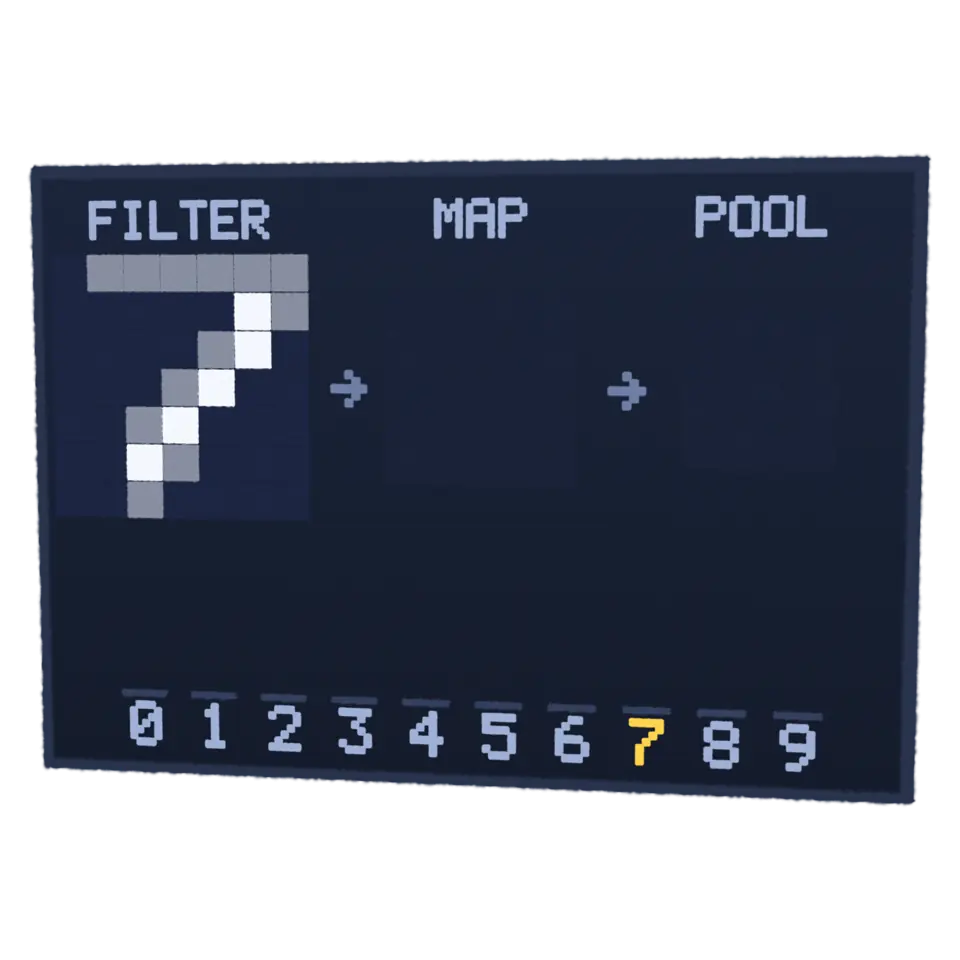
Fig. 33. §3 AI and Computing
ConvNet
A convolutional network, or CNN, is a neural network built for pictures.
1Facts
- Shelf
- AI and Computing
- Kind
- Built from a recipe
- Your own
- Draw a digit
- Sound
- Yes
- Licenses
- CC BY 4.0
2How to play
Tap it to read the digit. Draw your own digit in the Splash tab.
3Its controls
Table I. Every control on this Splash.
| Control | Kind | Range | Start |
|---|---|---|---|
| Read the digit | Tap | ||
| Read | Button | ||
| View | List | 3 choices | Poster (2D) |
4About it
A convolutional network, or CNN, is a neural network built for pictures. It slides small filters across the picture: each filter is a little grid of weights that lights up where it finds its pattern, such as a slanted stroke, and makes a feature map. Pooling shrinks the map, keeping the strongest signal in each patch, and later layers combine the features to recognize the whole shape.
Tap it: a glowing 3-by-3 filter slides over a handwritten 7, stamping a feature map tile by tile; the tiles pool into a smaller map, and the scores for the digits 0 to 9 rise with 7 on top. In the Splash tab, pick a 3D view, or draw a digit and a small trained network reads it. Each square on the drawing pad is one pixel of the small 8-by-8 picture the network reads: the lighter its gray, the more ink it holds, and the pad starts with the sample 7.
5Details
- Splats
- Opens at 200,000 at Mid Detail, 60,007 at Low, and up to 890,000 at Max
6Is it right?
The drawing pad runs a real small convolutional network with stored trained weights. Its test-set result reproduces the displayed 97.0%. The separate 7 diagram uses real filtering and pooling but prepared final digit scores.
Correct.
The drawing pad runs convolution, ReLU, pooling, dense scoring, and softmax.[1][2]
An independent tensor implementation matches every layer on ten samples and 64 random drawings to absolute error below 1e-10.
Correct.
The network reads 8-by-8 images from a named digit dataset.[3]
The asset identifies UCI Optical Recognition of Handwritten Digits; pixel values are scaled from 0–16. All ten stored samples classify correctly.
Close.
The displayed test accuracy is 97.0%.[3]
The exported network correctly classifies 1,743 of 1,797 original UCI test rows: 96.99499%, which rounds to 97.0%.
Correct.
The introductory filter and pooling calculate feature values.[1][2]
The 3-by-3 cross-correlation and ReLU produce a 5-by-5 map. Max pooling includes smaller windows at the edges.
Simplified.
The introductory digit scores are an illustration.[1]
The score array is stored separately from the filter and pooled values; its winning 7 is not inferred from that map.
- [1]Convolutions for images, Dive into Deep Learning authors
- [2]Pooling, Dive into Deep Learning authors
- [3]Optical Recognition of Handwritten Digits, UCI Machine Learning Repository; Alpaydin and Kaynak
- Simplified
- The introductory diagram uses one fixed filter on a 7-by-7 sample, a normalized feature map, partial edge pooling windows, and stored digit scores. The drawing network reads 8-by-8 grayscale pixels and does not retrain while drawing.
7Sources and credits
| Work | By | License |
|---|---|---|
| Optical Recognition of Handwritten Digits (UCI Machine Learning Repository) | E. Alpaydin and C. Kaynak (1998) | CC BY 4.0 |