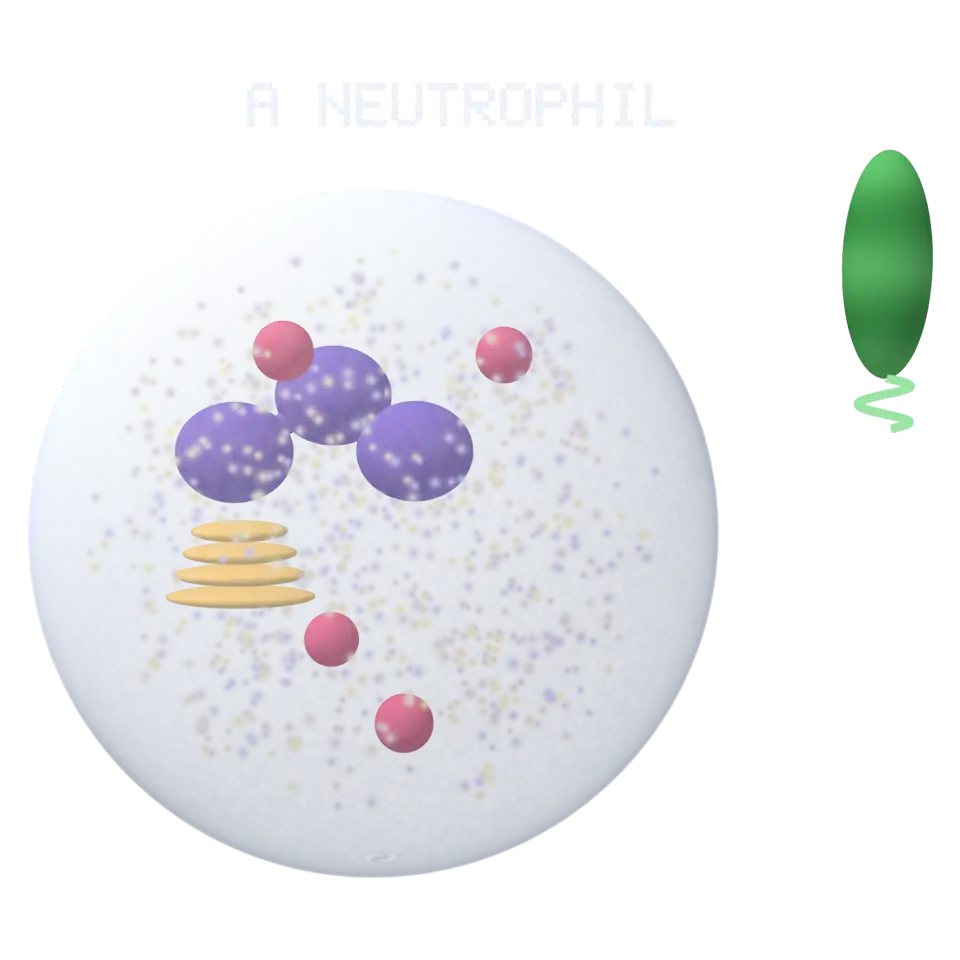
Fig. 394. §23 Tiny World
Phagocytosis
Phagocytosis means "cell eating".
1Facts
- Shelf
- Tiny World
- Kind
- Built from a recipe
- Sound
- Yes
- Licenses
- Own work (made in the page)
2How to play
Tap to watch the neutrophil catch and digest the bacterium.
3Its controls
Table I. Every control on this Splash.
| Control | Kind | Range | Start |
|---|---|---|---|
| Catch the bacterium | Tap | ||
| Eat | Button |
4About it
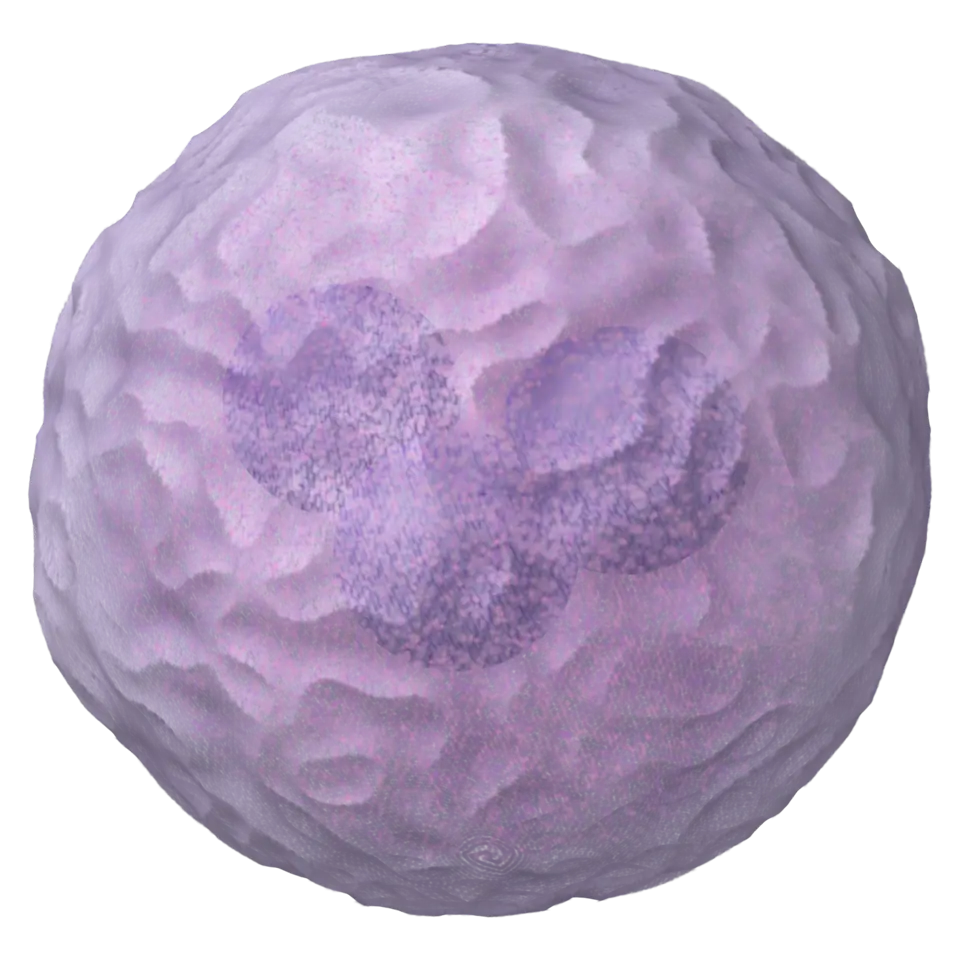
Phagocytosis means "cell eating". Tap and this neutrophil, a white blood cell, reaches out pseudopods around a bacterium until their tips meet, enclosing it in a bubble of membrane called a phagosome. Lysosomes, small sacs of digestive enzymes, fuse with it to make a phagolysosome, where the bacterium is broken down. The cell then releases the waste.
Neutrophils are the most common white blood cells; their nucleus has several lobes. A real neutrophil also kills with bursts of reactive oxygen; the splash shows the steps of eating.
5Details
- Splats
- Opens at 200,000 at Mid Detail, 60,000 at Low, and up to 780,000 at Max
6Is it right?
The splash shows a neutrophil eating a bacterium in the steps a microbiology textbook gives: pseudopods wrap it into a phagosome, lysosomes fuse to make a phagolysosome, it is digested and the waste is released. The cell and its parts are a clear diagram.
Correct.
The phagocyte wraps the bacterium in pseudopods and pinches it off into a membrane vesicle, the phagosome.[1]
The membrane near the bacterium reaches round it in two layers until the opening closes; a phagosome around the bacterium is then drawn into the cell.
Simplified.
Lysosomes fuse with the phagosome to form a phagolysosome, where enzymes digest the bacterium.[1]
Five lysosomes travel to the phagosome one after another and join it; it turns pink (a phagolysosome); the bacterium comes apart into six pieces that shrink.
Correct.
The leftover waste is released from the cell.[1]
The phagolysosome moves to the membrane and its remains go out of the cell.
Correct.
Neutrophils are the most common white blood cells, have a lobed nucleus and prefer to eat bacteria.[2]
The cell has a nucleus of three joined lobes.
- [1]Microbiology, 17.4 Pathogen Recognition and Phagocytosis, OpenStax
- [2]Anatomy and Physiology 2e, 18.4 Leukocytes and Platelets, OpenStax
- Simplified
- The bacterium swims to the cell; in the body the neutrophil also crawls toward it, following chemical signals (chemotaxis).
- Simplified
- The phagosome's acidification and the burst of reactive oxygen that neutrophils use to kill bacteria are left out.
- Simplified
- New lysosomes bud from the Golgi and a new bacterium arrives at the end, so the splash can play again.
- Simplified
- The cell is drawn about three times the bacterium's length; a real neutrophil (about 12 micrometers) is about six times a 2-micrometer bacterium.
7Sources and credits
Made in Splashery. Its code is MIT.